
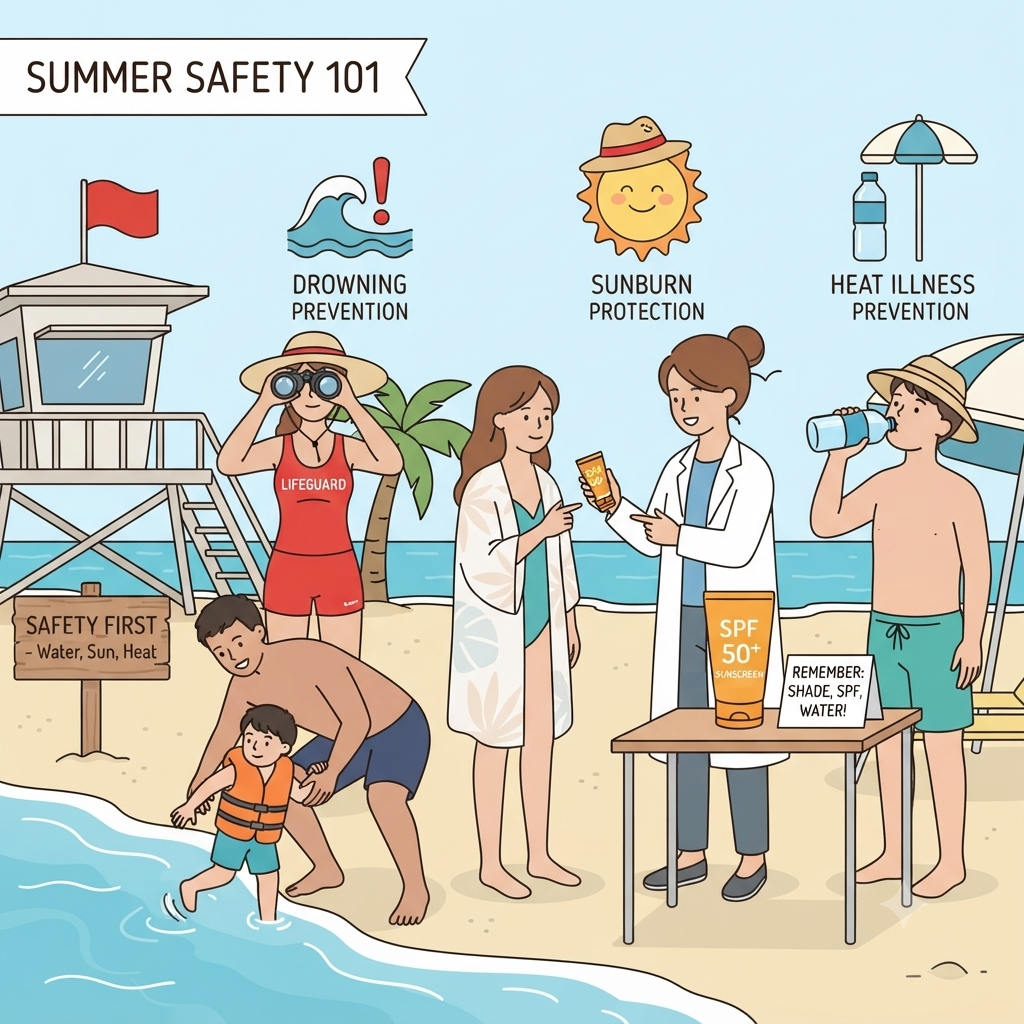
Summer brings pool days, cookouts, and a lot more time outside. Along with it comes an
increase in preventable injuries. Before the season gets away from us, here’s what we’d want
you to know about the three risks that come up most: drowning, sun exposure, and heat illness.
We can avert these accidents by keeping the following in mind:
Drowning is still the leading cause of death for kids ages 1 to 4, and the second-leading cause
of injury death for kids 5 to 14. What catches most parents off guard is how undramatic it
seems. There’s no splashing or yelling, usually just a quiet slip under the surface.
Having a dedicated “water watcher”, even if there’s a lifeguard on duty, can move the needle
here. An adult whose only job in that moment is watching the water; no phone, no book, no
catching up with a friend, etc., can go a long way towards preventing an accident. We advise
taking turns so nobody’s on the hook the whole day, and swim lessons help too. Kids can start
classes earlier than one assumes, starting from as young as age 1.
It’s also worth thinking in layers rather than relying on any one safeguard: a fence with a
self-closing, self-latching gate around a home pool, life jackets for new or weaker swimmers in
open water, and knowing CPR yourself. Home pools are the bigger risk for toddlers, while older
kids and teens are more likely to get into trouble in lakes, rivers, and the ocean, where currents
and drop-offs are harder to judge.
A sunburn isn’t just a bad day at the beach. It damages skin, adds up over a lifetime toward skin
cancer risk, and makes it harder for your body to cool itself, which is vital in the summer heat.
The standard we recommend is a broad-spectrum sunscreen of SPF 30 or higher, which blocks
roughly 97% of UVB rays. Interestingly, going well above SPF 30 doesn’t buy you much more
protection. Reapplication does the heavy lifting, not the number on the bottle.
A few things make sunscreen work: apply a generous amount (a shot glass is a decent guide for
a full body) about 15 minutes before you head out, giving it time to absorb. Reapply every two
hours, and right after swimming or sweating, no matter what the label promises. Water resistant only holds for 40 to 80 minutes before it needs a refresh. Sunscreen also works best alongside shade during the 10am-to-4pm stretch when UV is strongest. Add a hat and a swim shirt for kids who’ll be out there all day. For babies under 6 months, skip the sunscreen where you can and lean on shade and clothing instead, since their skin is more sensitive.
Heat and humidity can overwhelm the body faster than you’d expect, especially for young kids,
older adults, and anyone active outside. Left alone, heat exhaustion can turn into heat stroke,
which is a real emergency, not just “feeling overheated.”
The basics are simple: drink water before you’re thirsty, aiming for roughly 16 to 32 ounces an
hour during outdoor activity (skip the sugary or alcoholic drinks, they work against you). Wear
something loose, light, and light-colored. Add in shade or AC breaks rather than pushing
through the whole afternoon. And never, ever leave a child or a pet in a parked car, even briefly,
even with a window cracked. Temperatures inside climb faster than most people think.
Know the warning signs, too. Heavy sweating, dizziness, nausea, or cramping usually means
heat exhaustion, and it calls for cooling down and fluids right away. Confusion, hot or dry skin,
or passing out are signs of heat stroke, and that’s a 911 call, not a wait-and-see.
Keep one adult watching the water at all times, no distractions. Use SPF 30+ sunscreen, apply
it 15 minutes before you’re outside, and reapply every two hours. Stay hydrated and take breaks
from the heat. Never leave kids or pets in a parked car. And if something looks like heat
exhaustion or heat stroke, don’t wait it out.
If you’ve got questions about sunscreen for a specific skin type, hydration for a child with a
medical condition, or getting ready for a trip near water, give us a call. We’re happy to help you
get ahead of it.